Why Your Message Is Being Ignored (And It's Not Their Fault)
Health inspectors don't just need to know the facts. They need to make people act on them. And that lesson applies to every business owner and leader communicating today.
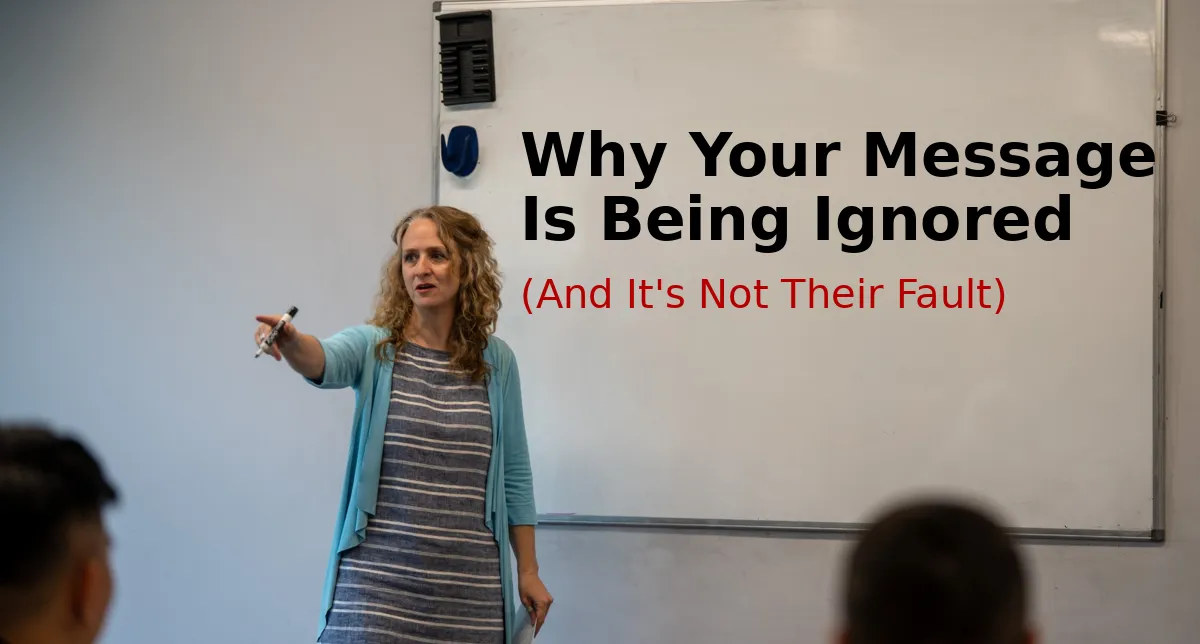
Every year, I walk into the same classroom at Concordia University of Edmonton to teach communications to Health Inspector students. And every year, I'm reminded of exactly why this work matters.
These aren't abstract messages. When a health inspector communicates, the stakes are real:
"There's contaminated food." · "There's a boil water advisory." · "This could impact your health."
My students are smart, educated, and capable. But most of them arrive with a common assumption — that if they deliver the information clearly, people will act on it.
That assumption is the single biggest obstacle to effective communication.
If your audience doesn't understand your message, it's not their fault. It's yours.
Communication isn't measured by what you say. It's measured by what people hear, understand, and do.
We map every channel — TV, radio, newspapers, social media, text alerts, posters, presentations — and then we ask the harder questions: Who is this message for? And why should they care?
This is where most public health messages — and most business messages — break down. People don't act on information. They act on relevance.
I asked my class: what is the most important thing your audience needs to know first? One student answered immediately: credentials. She believed that establishing authority would earn people's attention.
It's a reasonable instinct. But it's the wrong answer.
WIIFM — What's In It For Me The question every audience is asking before they decide whether to listen.
Credentials don't answer that question. Relevance does.
To make it real, I held up a gift card and asked the class who wanted it. Most hands went up — but not all. I asked one of the students who hadn't raised her hand why she passed.
"I don't like shopping," she said.
A free gift card sounds universally appealing — but it wasn't relevant to her. The offer didn't match her world, her needs, or her language. So she didn't reach for it.
That's exactly what happens when a message misses its audience. It isn't ignored out of stubbornness or inattention. It's ignored because it simply doesn't connect. I may as well have been speaking another language — she didn't hear me, because I hadn't taken the time to understand what mattered to her.
I failed to identify her problem, understand her need, and frame my message in a way that spoke to her. The cost? She didn't buy in.
Here's the deeper truth that sits beneath all of this:
People only act when they see a problem — and believe they have a way to fix it.
That's not a communications insight. That's human nature. And it has profound implications for anyone whose job is to move people to action — whether you're a health inspector, a marketer, a salesperson, or a leader.
Your job isn't just to deliver information. It's to help your audience see the problem they may not have fully recognized, understand what it's costing them to leave it unsolved — in public health terms, that cost can be illness or death — and then show them, in their own language, how your solution addresses it.
Step 1: Help them see the problem Step 2: Show the cost of inaction Step 3: Offer the solution in their words
That last part is the one most people skip. It's not enough to have the right solution — it has to be framed from the audience's perspective, in language that reflects their reality, not yours.
This is where key messaging comes in. I give my students one challenge:
Say it in 500 words. If you can't say it clearly, you don't understand it well enough yet.
Whether you're a health inspector, a business owner, or a leader — you are always trying to move someone to the same three outcomes:
✔ Understand ✔ Care ✔ Take action
That's not just public health. That's marketing. That's leadership. That's communication at every level.
And the delivery matters just as much as the message itself. We work on body language, tone of voice, and word choice — because how a message is received is inseparable from what it says.
Outside the classroom, I hear the same frustration from business owners and leaders:
"I've explained it. I've posted about it. People just don't get it."
Usually, the message isn't landing — and when it doesn't land, nothing moves. No action, no buy-in, no results.
This week's reflection:
If people aren't responding to your message — is it really them?
Or is your message not clear, not relevant, or not compelling enough yet?
Have you helped them see the problem — and shown them the cost of leaving it unsolved?
When your message gets clear — people listen, people understand, and people act.
That's the work.


