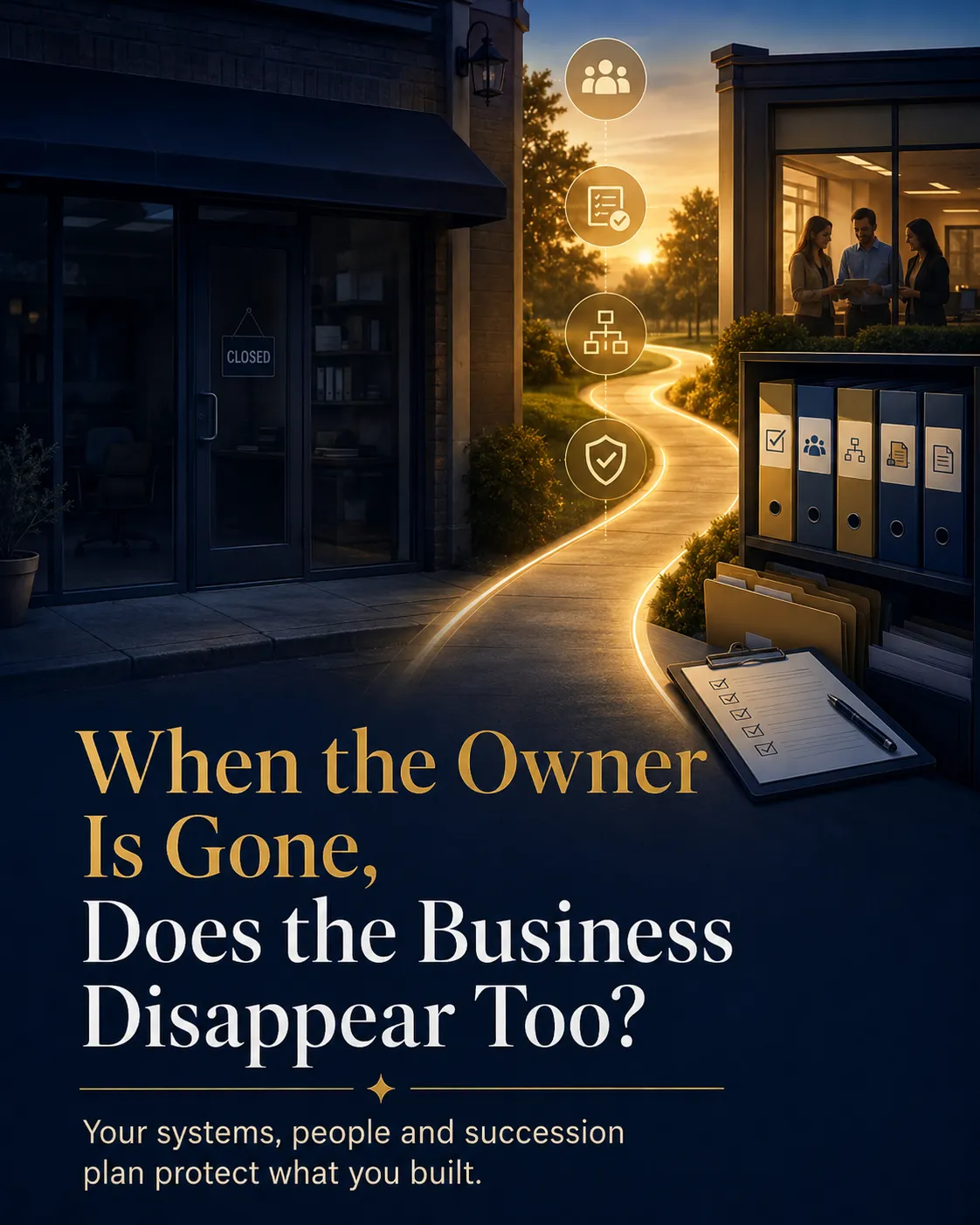
When the Owner Is Gone, Does the Business Disappear Too?
When the Owner Is Gone, Does the Business Disappear Too?
Most business owners spend years learning how to start, survive and grow.
Very few are taught how to leave.
That may become one of the greatest risks facing Canadian small businesses over the next decade.
According to the Canadian Federation of Independent Business, 76% of Canadian small-business owners planned to exit their businesses within ten years. Together, those businesses represent more than $2 trillion in assets.
Yet only 9% of owners had a formal succession plan.
Think about that for a moment.
Thousands of profitable businesses support families, employees, customers and entire communities—but many still depend heavily on one person.
The owner holds the key relationships.
The owner makes the difficult decisions.
The owner knows how every unusual situation should be handled.
The owner carries years of knowledge that has never been documented.
As long as that person is present, the business may appear successful.
But what happens when the owner is suddenly no longer available?
This Is Personal for Me
I witnessed this in my own family.
My dad and my brother both operated successful, profitable businesses. They worked hard, served their customers and created employment.
Then illness and death changed everything.
Their knowledge had not been fully transferred. Their systems and processes had not been documented in a way that someone else could confidently follow. There was no fully prepared successor ready to carry the businesses forward.
The businesses disappeared.
So did the jobs, the income and the opportunity to preserve what they had spent years building.
Their work and experience faded into the shadows when they should have become part of a lasting legacy.
I often wish I had known then what I know now.
Perhaps I could have helped them document the work, train another leader and create a plan that protected their families and employees.
I cannot change their stories.
But I can help other business owners change theirs.
A Profitable Business Is Not Necessarily a Transferable Business
A company can be busy, respected and profitable while remaining extremely vulnerable.
Ask yourself:
If you could not work tomorrow, who could confidently lead the business without repeatedly calling you?
Could your team continue serving clients at the same standard without the knowledge stored in your head?
Would your family inherit a valuable business—or a collection of responsibilities they do not know how to manage?
Would a buyer be purchasing a functioning company, or simply purchasing your job?
These are difficult questions.
They are also necessary questions.
A CRM Is Not the Entire Solution
Technology can create visibility, consistency and accountability. A CRM can track clients, automate communication, organize tasks and reduce missed follow-ups.
But software alone cannot preserve a business.
The company must also document:
How work moves from beginning to end
Who owns every responsibility
How quality is checked
How unusual situations are handled
When a matter must be escalated
How client relationships are maintained
How employees are trained
How decisions are made
Who can lead when the owner is absent
These become the company’s standard operating procedures, training tools and management systems.
They turn knowledge into a business asset instead of leaving it trapped inside one person’s head.
Succession Is a Process, Not an Event
A business cannot usually be made transferable a few weeks before the owner wants to leave.
BDC recommends beginning succession planning well in advance because an effective transition may involve:
Clarifying the owner’s personal and financial goals
Strengthening profitability and business value
Documenting systems and processes
Developing leadership within the team
Training a successor
Transferring important client relationships
Completing a professional business valuation
Addressing legal, tax and estate matters
Creating a written transition or sale agreement
Testing whether the company can operate without the owner
The successor may be a family member, a manager, a group of employees or an outside buyer.
Regardless of who takes over, they need more than the keys to the building.
They need the systems, knowledge, authority, relationships and leadership capability required to continue what the owner built.
What Is Lost When a Business Simply Closes?
When an unprepared business closes, the loss extends far beyond the owner.
Employees lose their jobs and financial stability.
Families may lose the value of an asset that took decades to build.
Customers lose trusted services.
Suppliers and referral partners lose business.
Communities lose knowledge, relationships, tax revenue and local ownership.
A business succession plan is therefore not only an exit strategy.
It is a continuity plan for everyone who depends on that company.
Your Business Should Become Bigger Than You
The ultimate test of a strong business is not how hard the owner works.
It is whether the company can continue producing results when the owner is no longer at the centre of every decision.
That requires systems.
It requires documented processes.
It requires trained people.
It requires honest conversations about ownership, leadership and the future.
And it requires beginning before illness, exhaustion or an emergency makes the decision for you.
You worked too hard to build a business that disappears when you leave.
Build one that protects your family, secures your employees and continues serving your community.
Build a business that carries your legacy forward.
This Week’s Leadership Question
If you were unable to work for the next 90 days, what would stop, slow down or fall apart?
Write down your answers.
That list is where your succession plan begins.
Is too much of your business still stored in your head?
I help owners build systems, document essential processes, develop their teams and prepare the business to operate successfully without their daily presence.
Text with LEGACY to begin the conversation: 639-638-3331


