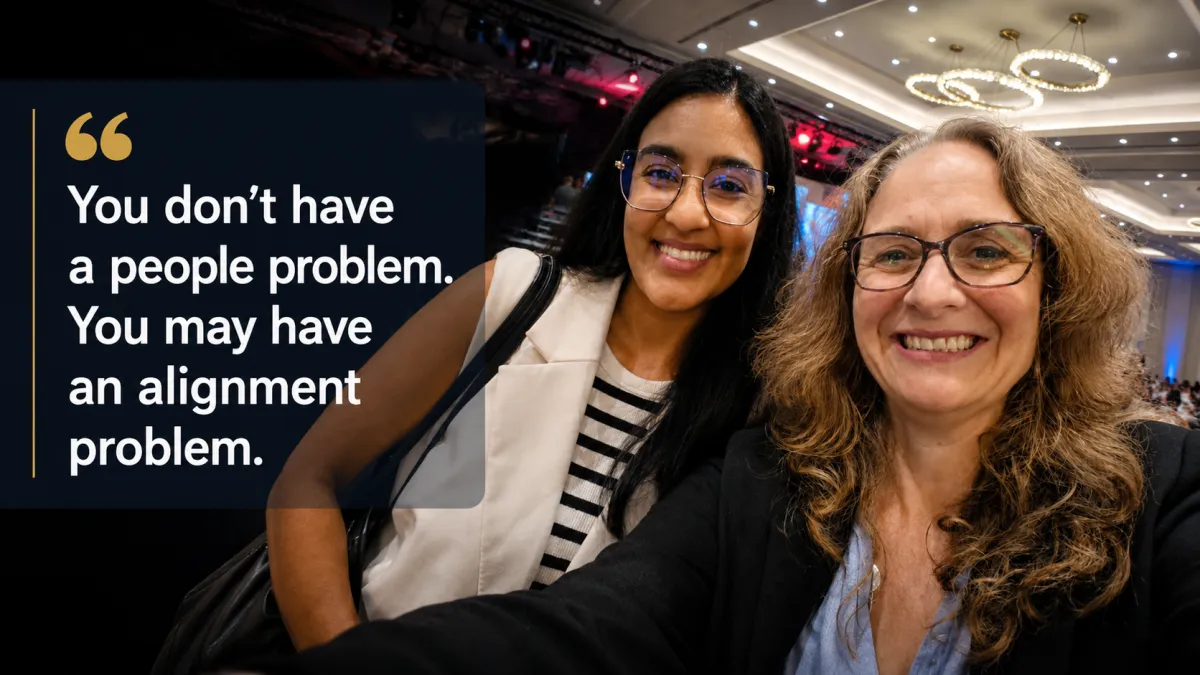
You Don't Have a People Problem. You May Have an Alignment Problem.
Miami 10X Business Summit — Part 3: People, Culture & Accountability
One of the most common things I hear business owners say is, "I just can't find good people." And to be fair — sometimes that's true. Good people really are hard to find.
But Day 3 of the 10X Business Summit challenged me to look at that statement differently. What if the problem isn't always the people? What if it's that we haven't built a business that actually knows how to find, select, align, develop, and hold great people accountable?
That was the theme running through my workbook all day: people alignment. One line I scribbled at the top of the page summed up where it all leads: build a bigger business and do less.
Not because the owner stops caring, or disappears. Because the business has developed people who can actually carry responsibility, instead of everything coming back to the owner by default.
Hiring Is Only the Beginning
One model from the session broke people development into three ongoing stages: align, develop, transition.
Align is hiring and onboarding someone into the business. Develop is helping them grow their skills, responsibility, and capability. Transition is the one people skip — changing roles and responsibilities as both the employee and the company grow.
That last one matters more than it sounds. The person who was perfect for your business at $500,000 in revenue may need a completely different skill set to help you build a $2 million or $10 million company. Sometimes the owner needs different skills too. Growth changes the job.
Which means the question isn't just "who do I need today?" It's also "who will I need for the company I'm actually trying to build?"
Start With the Future
One exercise asked us to look at our current team, then answer a bigger question: what's your 10-year revenue target? From there — how many people will you need to hire? And the more uncomfortable one: how many people may eventually need to leave or move into a different role?
That's strategic workforce planning. Most small businesses don't hire that way — they hire when someone quits, when the phones get too busy, when the owner finally can't take it anymore. Then it's a rushed job ad, three interviews, and picking whoever felt best in the room.
That's not a hiring system. That's just reacting.
Show Me, Don't Tell Me
This might have been my biggest takeaway from the hiring portion of Day 3: show me, don't tell me.
Almost anyone can interview well for an hour. "Are you organized?" "Yes." "Good with customers?" "Absolutely." "Hardworking?" "Of course." What did any of that actually tell us? Not much.
A better process looks for evidence instead. The Summit broke interviews into three areas: behavioural, technical, and values-based.
Behavioural
Ask about what they've actually done — what impact they made in past roles, whether they can explain their results, whether they bothered to research your company.
My note from this part of the session: ask the question, shut up, listen.
That's harder than it sounds. Business owners tend to get so busy explaining the company and selling the opportunity that they end up doing most of the talking — while the candidate tells us almost nothing.
Technical
If someone says they can do the job, let them actually show you. The exercise shouldn't be a trick — it should look like the real work. Hiring for social media? Don't just ask if they're creative. Hand them a realistic scenario, have them create something, and have them walk you through their thinking.
No tricks was the note I wrote here. The point isn't to catch someone making a mistake. It's to find out whether they can actually produce what you need.
Core Values
This one stood out to me most. Instead of asking a candidate "do you agree with our values" — which is an easy yes for anyone — have them actually demonstrate they've thought about them. One exercise had candidates research the company's core values and prepare a short presentation on them.
Think about what that reveals before they've even started: did they prepare, did they follow instructions, can they communicate clearly, do their actual behaviors line up with what they're describing? Now you're looking at evidence instead of just hearing the right answer.
Hiring Doesn't End With "You're Hired"
This is where a lot of businesses get into trouble. All that energy goes into recruiting and interviewing someone — and then Monday comes. "Here's your desk." "Ask Bob if you need anything." "Watch what Sarah does." "You'll figure it out."
Three months later we're frustrated: "they should know this by now." But should they? Were the expectations ever actually clear? Was there real onboarding, real training, real targets, real feedback — or did we just hire them and hope for the best?
Pay Attention to the First 90 Days
The message here was simple: don't ignore it. Write down what you're noticing, follow up on it during those first 90 days, address it, and use it to improve your next hire.
What we shouldn't do is justify every red flag, assume it'll fix itself, or tell ourselves it probably won't happen again. Sometimes it won't. Sometimes it will. Leadership just means being willing to find out which.
Culture Isn't the Sign on the Wall
My note from this part: the team has to want the same mission. That doesn't mean everyone thinks identically — it means people understand what the business is trying to accomplish and how their own job feeds into it.
Culture isn't five values printed on a wall. It's whatever actually gets talked about, taught, rewarded, measured, and tolerated. If accountability matters, there need to be targets. If customer service matters, measure it. If sales matter, track the activity that actually produces sales — calls, appointments, demos, deals, leads.
Vague expectations produce vague results.
Why Businesses Struggle to Build Great Teams
One workbook page listed five common reasons businesses struggle to hire and develop talent: no real commitment to growth, no top performers to model from, not enough clarity on mission and values, no repeatable process, and not enough coaching or mentorship.
That fourth one jumped off the page at me. No repeatable process. Because that's not only a hiring problem — it's a business problem. You can't expect consistency from people when the business itself runs differently depending on who's working that day.
The Owner Can't Be the System
Business owners tell me all the time, "everything comes back to me" — every decision, every complaint, every unusual situation, every approval. But when all the knowledge and standards live inside one person's head, the team stays dependent on that person, and the owner eventually becomes the bottleneck.
So maybe the goal isn't just to hire more people. It's to build better people systems: clear roles, clear expectations, a repeatable hiring process, real onboarding, training, targets, coaching, and an actual path for people to grow.
That's how you get to the note I wrote at the very start of the day: build a bigger business and do less. Not by doing less leadership. By building more leaders.
A Question for Business Owners
Before saying "I can't find good people," it's worth looking at your own people system first. Do candidates actually know what they're being hired to accomplish?
Is there a repeatable interview process, one that tests for capability instead of just conversation? Do new hires get real onboarding and training? Does everyone know exactly what they're accountable for?
What looks like a people problem is often a clarity problem, or a process problem, or an alignment problem. And unlike the labor market, those are things we can actually fix.
Next in the Miami series: more of the biggest lessons from the 10X Business Summit, and how they actually apply to real small and mid-sized businesses.
In the meantime, let's grab a coffee and see what your people systems look like! My cell phone is 306-241-4880 - call me anytime.
Today, I'm on my way back to our family farm for a visit, so I have five hours in the car to talk with you! ha!
Penny
PS: For more newsletters, check out my blog. We also offer two complimentary visits to our weekly Think Bigger Friday online mastermind for small business owners ready to grow and who want to be around like-minded people.
Nilsen Business Coaching & Consulting: Helping business owners get the business out of their head and into repeatable systems—so the company can grow without everything depending on the owner.


