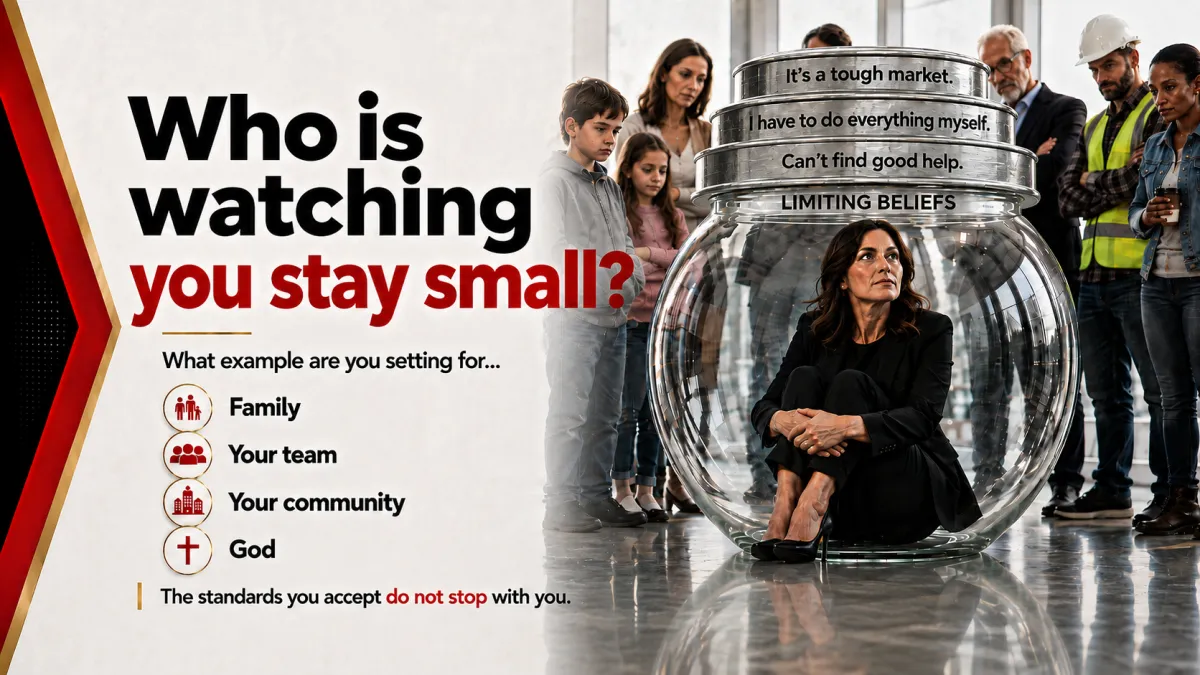
The Woman in the Jar Made Me Cry
I built a slide deck to make a point at my BNI Corman Park chapter presentation, and it ended up making the point to me first.
I'd just gotten back from the 10X Business Summit in Miami with pages of notes — ideas, questions, things I wanted to change — and since I think in pictures more than paragraphs, I turned my notes into images instead of another slide full of bullet points.
Then I got to one of them, and I honestly wasn't ready for it.
A woman, curled up inside a glass jar. A lid sealed shut above her head.
I didn't expect it to make me cry. But it did.
What got me wasn't that she was trapped. It's how she was trapped.
No dirt. No wall. She could see everything — the people, the room, the whole world outside that jar. Glass doesn't hide anything. She could see exactly what she was missing, and she still couldn't get out.
And this line hit me — the one I keep coming back to:
Who is watching you stay small?
Not "who might judge you." Watching. Your kids. Your spouse. Your team, quietly noticing what you'll put up with. Your community. For me — God, too.
The standards you accept do not stop with you.
This is the part I keep coming back to: they're not watching what you say you want. They're watching what you settle for. What you attempt, what you quietly walk away from, what you talk yourself out of before you've even tried.
So I had to ask myself the harder version of that question — what example am I setting from inside my own jar?
Here's the thing about limiting beliefs. They never show up labeled as one. They don't sound like fear. They sound like wisdom.
"It's a tough market." "I have to do everything myself." "Can't find good help."
Ordinary sentences. Reasonable ones. The kind we've all said this month, probably without noticing. We repeat them so often we stop questioning them, until one day they've quietly stopped being opinions and started being "the truth."
And once something becomes "the truth" in your head, you stop fighting it. You start building your whole business around it instead.
That's the moment a limiting belief stops being a metaphor and starts being a monthly bill.
Because mindset isn't just motivational talk — it's mechanical. Mindset drives behaviour, behaviour drives action, action drives results. If I believe nobody will pay my price, I hesitate right before I say the number. If I believe the market is terrible, I quietly prospect less. If good help doesn't exist in my head, I stop improving how I hire, and if I have to do it all myself, I keep taking work back from my team the second something goes sideways.
Then the trap closes on itself, because the result shows up exactly the way the belief predicted it would.
"See? I knew it wouldn't work."
The belief shaped the behaviour. The behaviour built the result. The result just proved the belief right. Limiting beliefs create income ceilings — and the lid gets a little tighter every month.
So sit with this one for a second:
What is your belief lid costing you — every month?
Not someday. Not over the next ten years. This month.
Here's what I didn't expect to learn in Miami: you can't just rip the lid off. "Stop thinking small" isn't a strategy, it's a bumper sticker. If you take an old belief away, you'd better have something stronger ready to put in its place.
So instead of "money doesn't grow on trees," I look for the opportunity that's already there instead of assuming there isn't one. Instead of "there isn't enough to go around," I remind myself it's everywhere — I just have to go get it. Instead of "money is the root of all evil," I see it for what it actually is: a tool. Character decides how it gets used. And instead of "money can't buy happiness," I remember everything it can buy — time, choice, freedom, access, the ability to actually help someone.
The next slide in my deck is called Replace the Lid, Expand the Belief. The lid's flying off. Arms out. The ceiling's gone.
Not because the market suddenly got easier. Not because I'm pretending it's all sunshine. Because I finally started asking the only question that actually matters — is that belief even true, or have I just repeated it long enough that it feels true? And underneath that one, the harder question: what would I do next if I didn't believe it?
That question alone rearranged a few things for me.
I still can't shake that first image, though.
The jar is glass. She can see the room. She can see the people. She can see exactly what's possible. And honestly, that might be the hardest place to live — not having no opportunity, but having it right in front of you, in full view, and still believing you can't reach it.
That's why that slide got me, and it's why I wanted to close out the Miami series on this one instead of on a strategy or a system.
I came home with sales ideas, leadership lessons, systems worth stealing. None of it outweighs the question sitting underneath all of it: what do I believe is possible?
10X calls it Bigger Rooms, Bigger Fish. But the room doesn't get bigger until MY belief does.
So here are the two questions I'm still sitting with. I'll leave them with you too.
Who is watching you stay small?
What belief lid is keeping you there?
Your next level probably doesn't start with a new CRM, another hire, another funnel, or another campaign. It starts with catching the one sentence you've repeated for years and finally deciding you don't believe it anymore.
The beliefs you keep will shape the income, the opportunities, and the life you let yourself go after.
Take the lid off. Then build something bigger.
— Penny
P.S. What belief showed up the second you started reading this? Don't wave it off — write it down. That's probably the lid worth breaking first.
Ready to stop defending your limits? Text or call me at 306-241-4880.
PPS: For more newsletters, check out my blog. We also offer two complementary visits to our weekly Think Bigger Friday online mastermind for small business owners ready to grow and who want to be around like-minded people.
Nilsen Business Coaching & Consulting Helping Business Owners Escape Day-to-Day Operations with Systems, Automation, Leadership & Team Accountability resulting in 30% more profit and legacy.


