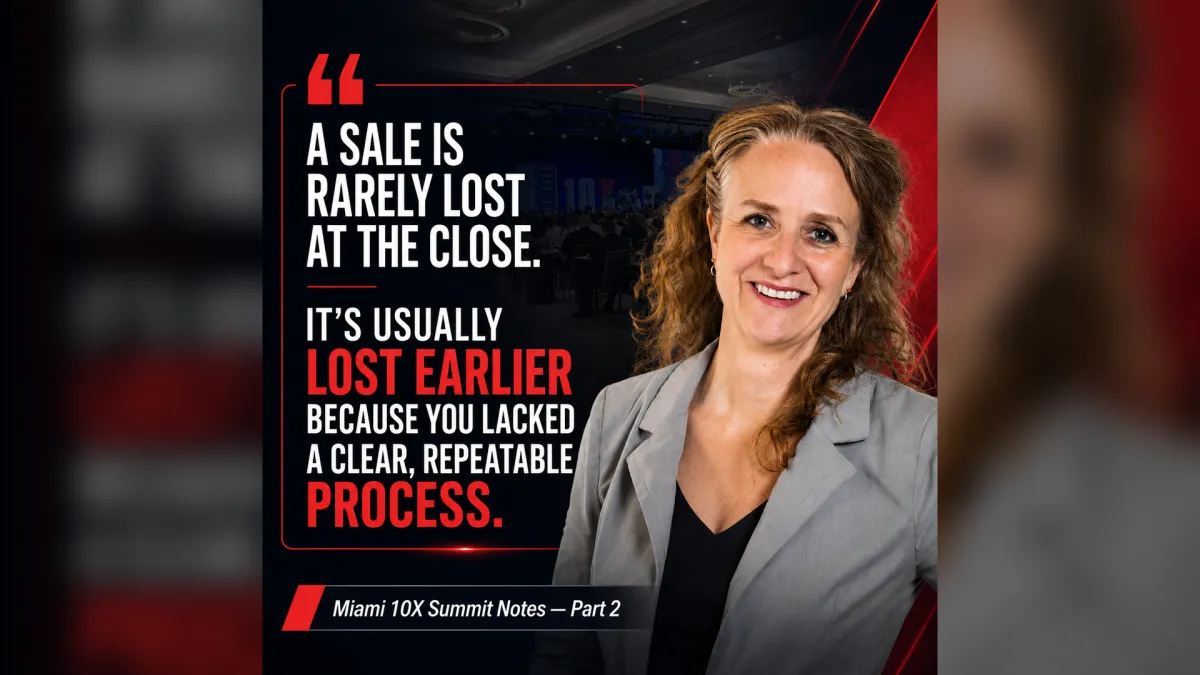
Miami 10X Business Summit — Part 2: Most Sales Are Lost Before the Customer Says No
Day One of the summit was about building the operational engine to support growth. Day Two went straight for the fuel that drives the engine: your sales process.
For the past 12 months, I’ve served as a certified 10X Business Coach, working with business owners to build repeatable systems and push past comfortable targets. But sitting in that room in Miami, working through the Day Two workbook, I had to hold myself to the exact same standard I hold my clients to.
I brought a strong background in communication, facilitation, coaching, and relationship-building to the table. I know how to listen, ask deep questions, and help people identify what’s blocking their progress. But as I reviewed my own pipeline, I had to ask myself some tough, direct questions:
Could I lay out my own sales process from start to finish?
Was it fully documented?
Could another coach or team member pick it up and run it tomorrow?
Was I measuring every single stage, or relying on intuition?
My honest answer was that it wasn’t where it needed to be.
That realization led to my biggest takeaway from Day Two: A sale is rarely lost at the closing stage. It is usually lost much earlier because the business never gave the salesperson a clear, disciplined process to follow.
Selling Shouldn't Depend on Personality
A lot of business owners lean on one "naturally gifted" salesperson—or carry all the sales weight themselves.
The story is always the same: "They just know how to talk to people, build trust, and read the room."
The problem is that instinct doesn't scale. When a sales process exists only in someone’s head, results fluctuate wildly:
One rep asks deep diagnostic questions; another rushes straight into a feature presentation.
One follows up five times with relevant insights; another gives up after a single unanswered email.
One confidently stands behind the full value of the offer; another lowers the price before the prospect even objects.
That isn't a sales system. That is a collection of individual habits.
A real 10X sales system must be clear enough to be explained, taught, practiced, measured, and continuously improved.
The 6-Stage Framework
The summit broke down the sales journey into six core stages:
Greeting
Qualifying
Presenting
Proposal
Closing
Follow-Up
The specific labels aren't what matter most. What matters is that everyone in your business knows exactly what is supposed to happen between first contact and final decision.
Without a defined process, salespeople are forced to improvise. Critical questions get missed, proposals become inconsistent, and follow-up depends entirely on memory. A documented process removes the guesswork. It turns sales from an unpredictable mystery into an engineered, manageable discipline.
The Stage Everyone Rushes (And Why It Costs You Deals)
A major focus of Day Two was qualification—or what I teach as Discovery and Fact-Finding.
This is where many sales calls fall apart. Reps listen just long enough to hear a single pain point, and then immediately launch into explaining everything their product or service can do.
Hearing a surface problem is not the same as understanding the situation.
A business owner might say, "We need a new CRM."
The deeper issue might be that leads are being ignored, staff are duplicating effort, the owner is personally answering every inquiry, and no one knows which deals are actually active.
The CRM isn't the problem—it’s just one potential tool for a much larger operational issue.
As coaches and educators, our job is to diagnose before we prescribe. We must seek to understand the customer before rushing to sell.
Diagnostic questions to uncover the real problem:
"Why is this a priority right now?"
"What have you already tried to fix this?"
"What happens six months from now if nothing changes?"
"How is this bottleneck impacting your team's day-to-day work?"
When you ask better questions, you help the prospect see their own situation more clearly—and you ensure you recommend the exact solution they actually need.
Stop Deciding for Your Customer: Make the Proposal
Another lesson from Day Two hit home: Present a clear offer to every genuine opportunity.
Many well-intentioned, service-minded business owners hold back out of a desire not to seem pushy. They offer advice, facilitate conversations, and build relationships for months, but hesitate to outline a formal offer. They decide on behalf of the customer—assuming they can't afford it, or waiting for a "perfect" moment that never comes.
Holding back a real solution isn't helpful. Once you understand a prospect's problem and know you can help, they deserve clarity:
Here is what I recommend based on what you shared.
Here is why this solution fits.
Here is the expected outcome.
Here is the investment required.
Here are the next steps to get started.
A proposal isn't a demand. It is a clear, structured path forward.
Asking for the Decision Is an Act of Service
Many professionals feel comfortable educating and consulting, but freeze when it comes time to ask: "Are you ready to move forward?"
It’s understandable—nobody wants to pressure a client or damage trust. But there is a fundamental difference between high-pressure manipulation and helping someone make a firm decision to solve a problem.
Closing isn't about pushing someone into something they don't need. It’s about checking whether they have enough information to take action.
An objection is rarely a flat "no." More often, it’s a request for clarity, a hidden uncertainty, or a sign that another decision-maker needs to be involved.
Direct, respectful closing questions:
"Have you seen enough to feel confident making a decision today?"
"Is there anything critical we haven't addressed yet?"
"Is the main hesitation the timeline, the solution itself, or the investment?"
When your process gives you clarity, an objection becomes an opportunity to educate rather than a reason to retreat.
Follow-Up Must Add Value
Most businesses follow up once or twice and then stop. They worry about being annoying, the lead gets buried under newer tasks, and eventually no one remembers who last reached out.
In 10X coaching, we know that persistence matters—but persistence only works when paired with relevance.
Effective follow-up shouldn't mean sending repetitive "just checking in" messages.
Every touchpoint should offer value:
Share a useful resource or industry article.
Send a short video answering a specific question raised earlier.
Share a brief case study of a similar client outcome.
Invite them to an upcoming workshop or event.
The goal isn't just to reappear in their inbox. The goal is to continue guiding them through their decision-making process.
Complaints and Unsold Leads Are Source Material
One exercise asked us to identify every potential source of sales opportunities. Beyond standard answers like referrals and inbound calls, one stood out:
Complaints.
A complaint means a customer cares enough to speak up. Handled quickly and attentively, a complaint gives you a chance to repair trust and fix an underlying process gap.
The same applies to lost deals. A "no" contains valuable feedback if you take the time to review it:
Was the timing wrong?
Was the offer unclear?
Did we miss the real decision-maker?
Did our follow-up stop too early?
Every lost opportunity can teach you how to refine your system—if you capture the data and review it consistently.
Training Requires Daily Repetition
A documented process is only useful if your team actively practices it.
We wouldn't expect an athlete to perform at a high level without regular practice reps. Yet businesses routinely expect salespeople to handle crucial client conversations after reading a script or manual once.
Effective sales training should be an ongoing habit:
Practicing discovery questions.
Role-playing realistic objections.
Reviewing real client calls.
Refining the transition into the proposal.
Role-play can feel awkward, but that is precisely why it works. It allows people to make mistakes in practice so they can operate with confidence in front of the customer.
My Day Two Takeaway
Day Two reinforced a simple truth: Sales is not an innate personality trait. It is a system.
A well-designed sales process respects the customer. It doesn't rely on talking someone into a purchase they don't need; it creates a clear structure to diagnose real problems, present genuine solutions, and guide clients toward a clear decision.
The most effective salesperson isn't the one who talks the most. It is the one who listens carefully, asks thoughtful questions, and consistently executes a dependable process.
Before asking your team to increase their close rate, take a look at your underlying structure:
Have you given them a sales process they can clearly follow?
Coming in Part 3: What Day Three taught me about culture, leadership, and building an organization that can scale past the owner.
In the meantime: Where in your current sales journey are prospective clients most likely falling through the cracks?
Penny
PS: For more newsletters, check out my blog. We also offer two complementary visits to our weekly Think Bigger Friday online mastermind for small business owners ready to grow and who want to be around like-minded people.


